What happened in 2023
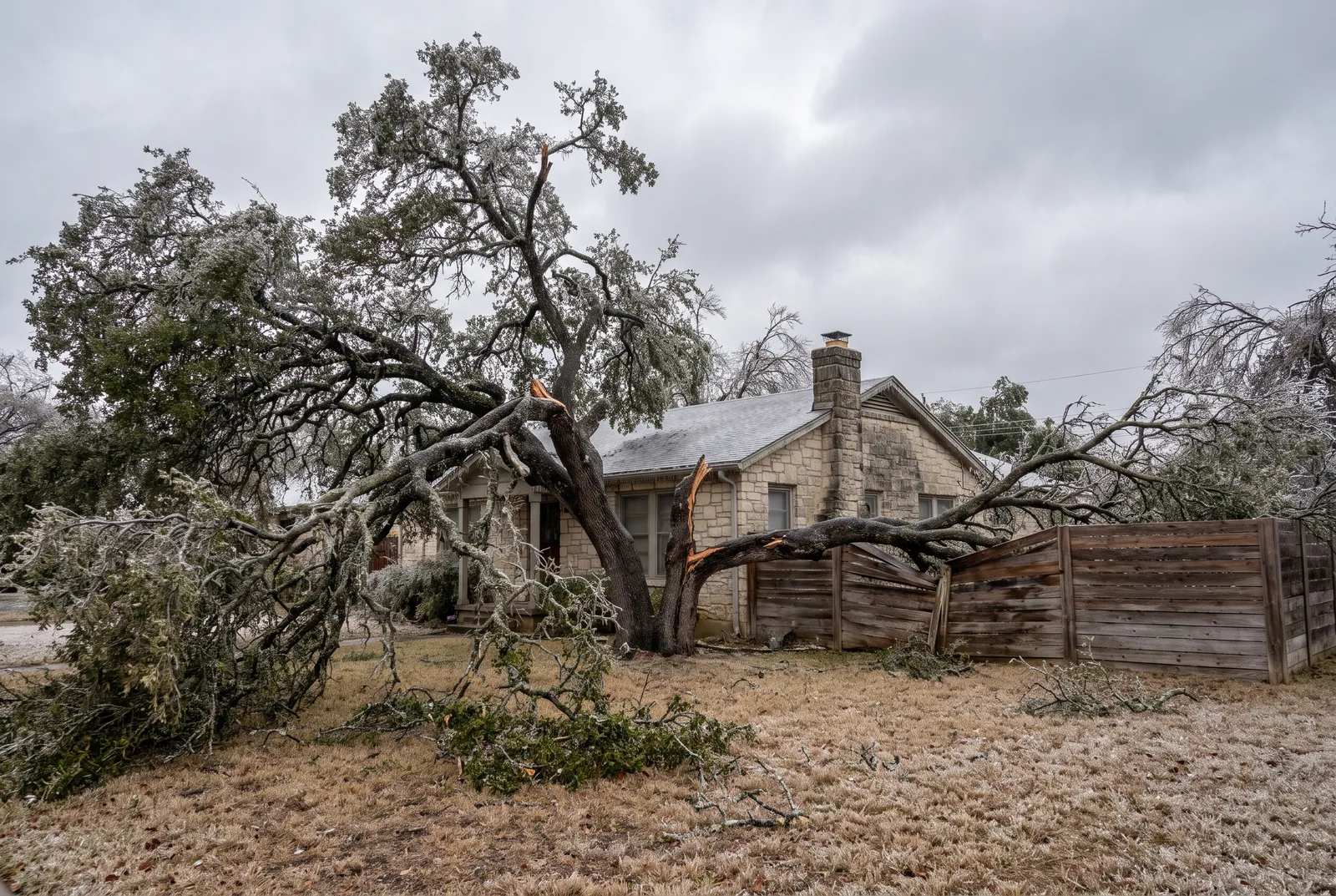
From January 31 to February 2, 2023, freezing rain fell on Georgetown for the better part of three days, and the ice built up to half an inch and more on everything that held still. When it was over the city hauled nearly 120,000 cubic yards of tree debris off its curbs — five to six times the roughly 30,000 cubic yards Winter Storm Uri left in February 2021 — at a cost of about $2.5 million. At the peak, about 3,700 of Georgetown Utility Systems' 31,730 electric customers were without power, almost all of it from limbs on lines. Streets in Old Town, Sun City and along Williams Drive were impassable under fallen live-oak limbs for days.
Why live oaks break in ice
Three reasons, and they stack. First, live oaks are evergreen — every leaf is a surface for ice to build on, while a bare cedar elm or pecan carries a fraction of the load. Second, the math: a half-inch of ice adds roughly 7,000 pounds to the canopy of a 30-inch live oak, all of it hanging on limbs that evolved for heat and drought, not load. Third, the shape: a mature live oak's leaders are long, flat and end-heavy, and the old forks where two leaders meet often have bark folded into the union instead of solid wood. Ice loads the ends, the lever gets longer, and the union lets go. That's why so much of the 2023 damage was big, healthy trees losing a third of their crown at once rather than dead trees falling over.
Which trees fail, in order
- Live oak — long leaders, included-bark unions, evergreen. The bulk of every ice-storm call.
- Bradford pear — every fork is weak; they split to the ground.
- Cedar elm and hackberry — fast wood, tight forks, mistletoe adding weight. Limbs and whole leaders.
- Arizona ash and Chinese tallow — brittle, short-lived, usually already declining.
- Pecan — sheds big limbs from the tips, especially old ones over houses.
- Ashe juniper (cedar) — bends, sometimes flattens, mostly survives.
- Post oak, bur oak, chinquapin oak — bare in winter, strong wood; they mostly stand.
What actually helps
End-weight reduction
Shortening the long, flat live-oak leaders back to a strong lateral takes the lever arm out of the equation. Done properly it's invisible from the street and it's the single most effective thing you can do to a spreading live oak before winter. Done between July and January, cuts painted.
Cabling and bracing
A live oak with one weak fork can have its leaders tied together with a steel or synthetic cable high in the crown so they load each other instead of pulling apart. A fork that's already cracked gets a through-rod. See cabling and bracing.
Crown cleaning and ball moss
Dead wood and heavy ball moss add weight and catch ice. Cleaning the interior of a live oak every three to five years takes both out.
Removing what can't be saved
Bradford pears over the roof, split cedar elms, dead post oaks. These aren't pruning candidates; they're removals, and they're cheaper in November than in the storm.
What doesn't help
Topping. A topped live oak grows a mop of weakly attached shoots that catch more ice and break worse. It's the one thing that makes the next storm worse than the last one.
The morning after
Stay away from anything touching a power line and call GUS. Photograph everything before it's touched. Don't cut a limb that's under tension or a trunk that could spring. Call for the tree on the house first, the hangers over the driveway second, the yard third — and get a written price from whoever you hire, because the trucks that appeared in February 2023 with out-of-state plates quoted by the hour, pruned oaks in the middle of the oak wilt window with unpainted cuts, and were gone by March. If a storm-broken oak limb has to be cut in February, it gets cut and painted the same minute; that's the exception the calendar allows.
Before the next one
Book the big live oaks for a look in the fall. Reduce the end weight on the leaders over the house, cable the weak forks, clean out the dead wood and the ball moss, take out the Bradford pears — and do it between July and January so the oak wilt rules are met. Georgetown gets a real ice event every few winters; 2021 and 2023 were two years apart.
Common questions
How often does Georgetown get ice storms?
Every few winters. February 2021 (Uri) and the January–February 2023 storm were two years apart; before that, the February 2011 and January 2007 ice events. Plan on one.
Should I have my live oak thinned before winter?
Reduced, not thinned. Taking weight off the ends of the long leaders is what prevents ice breakage; hollowing out the interior of a live oak does little and can make it worse. Our arborist will show you the cuts.
Can a live oak that lost a third of its crown recover?
Usually, yes — live oaks are resilient. The broken stubs need proper cuts back to the collar, painted, and the tree needs a year of water and no further stress. What matters is whether the remaining forks are sound.
Who do I call about a limb on the power line?
Georgetown Utility Systems, (512) 930-3640, or 911 if it's arcing or on the ground. Don't go near it and don't let a tree crew touch it until the line is cleared or dead.
Does insurance cover ice-storm tree damage?
If the limb hit the house, the fence or the car, usually — see our insurance guide. A limb that fell on the lawn is on you.
Related: Emergency tree service · Storm cleanup · Cabling & bracing · Live oak & post oak care